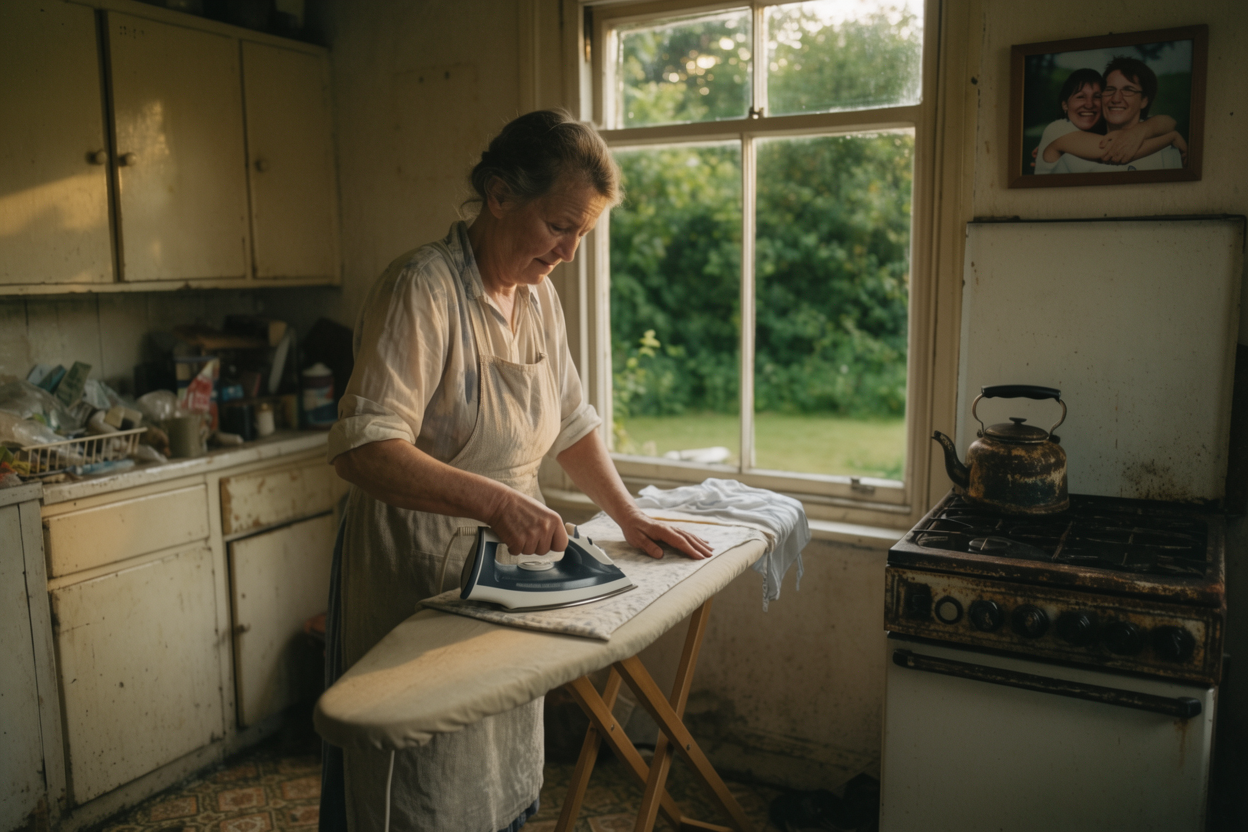
A woman ironing at the window of a well-used kitchen, pleased with herself, morning sun coming in off a green garden, a framed photograph of a laughing couple on the wall beside her

Short Fiction·Three Stories·Not for Sale


01The Number

The wallet had gone soft at the corners and Arthur had been meaning to replace it since the spring. He tipped it out onto the kitchen table because that is what you do, and the table filled up with the sort of thing a wallet holds after eleven years. Two library cards for the same library. A raffle ticket. A photograph of a dog that had been dead since the Clinton administration and had never, in life, sat that still.

And a piece of paper folded into eighths, worn through at two of the creases, with a phone number on it in blue ballpoint. No name. No area code, which dated it, and no clue at all as to whose hand had written it, because it was not his.

He looked at it for a while. Then he picked up the phone, because he was sixty-four years old and had run out of reasons not to do things.

It rang a long time. He was composing the apology when a woman said, "Hello?" in the guarded way people say it now.

"I'm going to sound ridiculous," Arthur said.

"All right."

"I found your number in my wallet. I don't know how long it's been in there. I don't know whose handwriting it is. I was hoping you might."

There was a pause of the kind where you can hear a kitchen.

"Read it to me," she said.

He read it to her. She said that was her number, and had been for thirty-one years, and before that it had been her mother's, so possibly longer than that, depending how you counted.

"And you're not — " Arthur stopped. He had no end for the sentence.

"I don't think so," she said. "What's your name?"

"Arthur Selkirk."

"No," she said, not unkindly. "Nothing. Should it be?"

"I have no idea. That's the whole problem."

She laughed at that, a short one, and he heard her sit down. A chair leg went over a floor. She said her name was Maureen and she was seventy-one and she had about forty minutes before she had to be somewhere, and they could either hang up now or try to work it out, and she didn't much mind which.

They tried to work it out.

He had lived in Ohio until he was thirty. She had never been to Ohio. She had taught school in two towns, neither of which he had heard of, and had worked one summer at a cannery, and he had never in his life been inside a cannery. He had been a heating engineer, twenty-six years for the same firm, and she said that sounded useful, and he said it was, mostly, and neither of them said anything for a second because that is a thing people say when the conversation has run out of road.

"My brother had a boat," Arthur offered.

"I don't know your brother."

"No."

"Lots of people had boats."

"He did not really have a boat," Arthur said. "He had a hull and a tarpaulin and an opinion."

She liked that. He could tell because she stopped being careful.

She told him about a dog she had inherited from a neighbour who went into a home, a huge stupid animal that would not go through a doorway if the door was standing open, only if you shut it first and then opened it in front of him, so that he could see it happen. She said it took her four months to work that out and by then she had started doing it without thinking, opening doors for a dog in a house where nobody was watching.

Arthur said his dog had been the opposite. His dog had gone through a screen door twice.

"Twice," she said.

"He didn't learn a great deal."

"Well, the second time he knew it would work."

They got on to the number again. She thought perhaps it had been a chain — somebody had given it to somebody who had given it to him, for some reason that had made sense at the time and that neither party had thought to write down. She said that was probably it. He said probably.

"It's a pity," Maureen said. "There ought to be an answer."

"There is one," Arthur said. "Somebody knows. They're just not here."

She said that was true of a great deal.

Then she said she had to go, she had a thing, and he said of course, and she said it had been a nice way to lose forty minutes, and he agreed that it had.

"Arthur," she said, before he could go. "Did you ever hurt your hand?"

He said no. He said why.

"No reason," she said. "It's just — my mother had a number in the book for a man with a hurt hand. That's all it said, in the margin. Hand. I never found out who it was, and I've never been able to throw the book away, and I don't know why I'm telling you."

"I've never hurt my hand," Arthur said.

"No. Well."

They said goodbye properly, the way people of their generation do, twice each.

Arthur sat for a minute. Then he swept the raffle ticket and one of the library cards into the trash and put everything else back — the dog, the other card, and the piece of paper, refolded along its worn creases so it would sit flat.

Somewhere in the drawer under the telephone was a pair of gloves he had bought in 1994 and never worn, because the right one had been sewn wrong at the thumb and the seam sat across the joint, and he had kept meaning to take them back.

He did not think about the gloves. There was no reason to. He put the wallet in his pocket and went out to see about the gutter.


02Tuesdays and Fridays

My uncle wound the clock in the Baptist tower for thirty-one years, and when he died the job came to me the way a coat comes to you - nobody asks, it is just suddenly on the hook by your door.

Tuesdays and Fridays, seven in the morning. Ninety-two stairs. The key is a piece of iron about the size of a forearm and it lives in a coffee can on the third landing, because my uncle got tired of carrying it up.

I did it for four months before I found out the clock is electric.

It has been electric since 1987. There is a small grey box bolted to the joist behind the face, and a cord, and the cord runs to the same outlet the vacuum uses. The winding mechanism is still there. The key still fits it. The gears still turn when you crank them. They are just not attached to anything anymore. They turn the way a doorknob turns on a door that has been taken off its hinges and leaned against the wall.

I sat down on the top step with the key across my knees and did the arithmetic. My uncle was fifty-one in 1987. He wound nothing, twice a week, for thirty-one years.

I went across the street to ask the pastor about it. He said "oh" in the way people say it when they assumed you already knew, and then he said everyone knew, and then he went back to what he had been doing.

So I asked around a little, carefully, the way you ask when you are trying to find out whether you are the joke. The woman who runs the bakery on the corner said she had known since her wedding. She said her mother had known. Then she said - while counting rolls into a bag, not looking up, the way you'd mention the weather - that she starts her second proof when she hears the tower door shut at the bottom, because my uncle was never off by more than a minute, and neither, so far, am I.

I have been doing it eleven years now.

Ninety-two stairs, Tuesdays and Fridays, seven in the morning. The key gets heavier every year and the can has rusted through at the bottom. I have never mentioned any of this to anyone in town, and no one has ever mentioned it to me, and every Friday at about ten past seven there is bread.


03The Appraisal

We do valuations on the second Tuesday, ten until two, and the rule is ten minutes a person. I have been doing it eleven years. In that time I have told four people they were rich and several hundred that they were not, and I have got quite good at the face you make.

Mr. Rennick came in at twenty past eleven with a biscuit tin.

I want to be fair to the tin. It was a good tin, Huntley & Palmers, the lid still seating properly, which they mostly do not. He set it down and took the lid off and turned it toward me, and it was buttons. Three or four hundred buttons. The kind of tin of buttons that is in every house in England, put there by a woman born before the war and never gone through by anybody since.

"Right," I said.

"There's a lot of them," he said.

There were. I put my hand in and let them run, because you do, and because it buys you a few seconds to decide how you are going to say it. Bakelite. Horn. A great deal of plastic. Four military, all common, all brass, one with the anodising gone at the rim. At the bottom, the way there always is, a single earring and a key to nothing.

Ten minutes. I had the whole of it in ninety seconds.

I said, "May I?" and tipped a few out onto the felt, and I started telling him what they were.

I told him about horn, and how you can tell it because it warms up in your hand and plastic does not. I told him the four brass ones were Royal Artillery and that there are more Royal Artillery buttons in England than there are people, which is the sort of thing that makes someone laugh who was braced not to be laughed at. I showed him the back of a black one and the little mark on it, and said the firm that made it was in Birmingham and went in 1953, and that this button had been sewn onto something and cut off it again at least twice, because you can see it, there, and there.

He leaned in when I said that. Both hands on the table.

At about six minutes I understood what I was doing, and I want to be exact about this, because I have thought about it since. He had not asked me what they were worth. Not once. Not when he came in, not when I tipped them out. A man who thinks he might have something asks inside the first sentence. They cannot help it. It is the only question there is.

So he knew. He had known before he parked the car.

I went on for the full ten minutes. I did not hurry and I did not pad it either, because he would have heard that, and it is an insult. At the end I put the four brass ones back in myself, which I do not normally do, and I said that as a lot it was a pound, maybe two, and that he should not break it up because it was worth more as a tin than as buttons, and he said, "No, I wouldn't do that," slightly offended, as though I had suggested something coarse.

He put the lid on. It seated properly.

"Thank you," he said. "She'd have liked that. About the Birmingham one."

And then he did not say anything else about her, and neither did I, and he took his tin and went out past the queue.

I had a woman after him with a teapot she was certain about. She was not right either, but she wanted the number, and I gave it to her in under a minute and she was gone, and that is the usual shape of it.

Six weeks later he was back, second Tuesday, twenty past eleven, with a different tin. Cadbury's this time, and inside it was thread. Reels and reels of thread, and a paper of needles, and a tape measure that had given up at about forty inches.

He set it down and took the lid off and turned it toward me and did not say anything at all.

I looked at the clock over his shoulder. My eleven-thirty was a man with a medal I could see from where I sat was a reproduction, and he was going to take it badly however long I spent on it.

"Right," I said. "Well. The reels first."